Chocolate production and uses
in 17th and 18th centuries
 Chocolate is a typically sweet, usually brown, food preparation of Theobroma cacao seeds, roasted and ground, often flavored, as with vanilla. It is made in the form of a liquid, paste or in a block or used as a flavoring ingredient in other sweet foods. Cacao has been cultivated by many cultures for at least three millennia in Mesoamerica. The earliest evidence of use traces to the Mokaya (Mexico and Guatemala), with evidence of chocolate beverages dating back to 1900 BC. In fact, the majority of Mesoamerican people made chocolate beverages, including the Maya and Aztecs,who made it into a beverage known as xocolātl /ʃoˈkolaːt͡ɬ/, a Nahuatl word meaning "bitter water". The seeds of the cacao tree have an intense bitter taste and must be fermented to develop the flavor.

Table of Contents
° Brief history of chocolate
° Chocolate production and uses between 17th
and 18th centuries in North America
° Chocolate production and uses between 17th
and 18th centuries in England
° Video about chocolate production
° Citations


- A brief history of chocolate
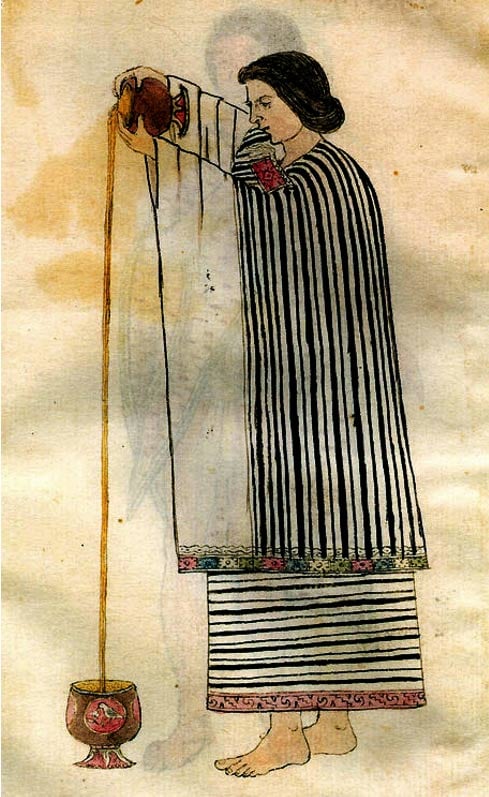
Chocolate has been prepared as a drink for nearly all of its history. For example, one vessel found at an Olmec archaeological site on the Gulf Coast of Veracruz, Mexico, dates chocolate's preparation by pre-Olmec peoples as early as 1750 BC. On the Pacific coast of Chiapas, Mexico, a Mokaya archaeological site provides evidence of cacao beverages dating even earlier, to 1900 BC. The residues and the kind of vessel in which they were found indicate the initial use of cacao was not simply as a beverage, but the white pulp around the cacao beans was likely used as a source of fermentable sugars for an alcoholic drink. An early Classic-period (460–480 AD) Mayan tomb from the site in Rio Azul had vessels with the Maya glyph for cacao on them with residue of a chocolate drink, suggests the Maya were drinking chocolate around 400 AD. Documents in Maya hieroglyphs stated chocolate was used for ceremonial purposes, in addition to everyday life. The Maya grew cacao trees in their backyards,and used the cacao seeds the trees produced to make a frothy, bitter drink.

By the 15th century, the Aztecs gained control of a large part of Mesoamerica and adopted cacao into their culture. They associated chocolate with Quetzalcoatl, who, according to one legend, was cast away by the other gods for sharing chocolate with humans, and identified its extrication from the pod with the removal of the human heart in sacrifice. In contrast to the Maya, who liked their chocolate warm, the Aztecs drank it cold, seasoning it with a broad variety of additives, including the petals of the Cymbopetalum penduliflorum tree, chile pepper, allspice, vanilla, and honey.
The Aztecs were not able to grow cacao themselves, as their home in the Mexican highlands was unsuitable for it, so chocolate was a luxury imported into the empire. Those who lived in areas ruled by the Aztecs were required to offer cacao seeds in payment of the tax they deemed "tribute". Cocoa beans were often used as currency. For example, the Aztecs used a system in which one turkey cost 100 cacao beans and one fresh avocado was worth three beans.

- Chocolate production and uses between 17th and 18th centuries in North America

 What is known; however, is following chocolate is more American than apple pie. It was created in the New World after the Spanish conquest of Mexico. While it combined ingredients from the Old World and the New, it was new to both. Neither exclusively Spanish nor Azetc, chocolate was the Creole (i.e., American, in the larger sense) invention. It was available to a greater variety of people and a cheaper prices than in Europe. This was because the raw ingredient, coca, was available without the high transportation costs or import duties experienced by the Europeans. Furthermore, most chocolate in North America was mass produced for an American market on machines that were invented and built in America. There were no monopolies or exclusive manufacturing agreements in North America as there were in Europe. American chocolate manufacturers were concentrated in four major production centers Boston, Newport (Rhode Island), New York City, and Philadelphia. Chocolate makers in these cities were the exclusive of the North American market. Practically no chocolate came from Britain or anywhere else. We also know that chocolate was accepted along with coffee and tea as a staple and was considered a necessity. While the recipes were ostensibly European, American chocolate practices reflected a different experience. After the American Revolution, the surviving Boston chocolate makers consolidated their dominance of the infant industry. Their surnames became iconic and these icons evolved into brands. Likewise, chocolate as a confection became more available as the confectioners trade was established in the cities.

- Chocolate production and uses between 17th and 18th centuries in England
 The first notice of chocolate in England appears in an advertisement in the Public Advertiser or Adviser during June 1657, informing the London public that "in Bishopsgate Street, in Queen's Head Alley, at a Frenchman's house, is an excellent West India drink called chocolate to be sold, where you may have it ready at any time, and also unmade, at reasonable rates."The spread of the use of cocoa and chocolate in England has been progressive since that date, and during the 18th century the Chocolate Houses of London were numerous and world famous. The chocolate of the Chocolate Houses was very expensive and, as would be expected, was the drink of the rich. The high price of cocoa largely resulted from the Spanish monopoly, since it was then almost wholly grown in the Spanish colonies of Central America. Supplies reaching England, Holland and other Western countries were chiefly obtained by British and Dutch privateers who intercepted and captured cocoa laden ships on their way to Spain. It is on record that during many years, more cocoa found its way to London and Amsterdam than to the Spanish ports.
 Spain was on the decline, and gradually cocoa came on the market as a normal article of trade, a process helped by the British, French and Dutch acquisition of West Indian possessions in which they were not slow to develop cocoa plantations for their own use. Up to the end of the 18th century, the stress had been on producing chocolate as a drink, but the knowledge of the behaviour of the cocoa and sugar mixture had been growing. With increased use, it had become necessary for the Chocolate Houses to carry stocks of chocolate paste, and it had been found that the careful roasting and blending of the beans together with the intimate mixing of the roasted cocoa and sugar greatly improved the flavour of the chocolate. These pastes, moulded for convenience in keeping and using, were the true forerunners of our present eating chocolate, but were prevented from becoming popular sweet-meats because of the high price and scarcity of cocoa and the very costly and time consuming hand labour required in their production.

- Video about chocolate production
- citations
- Wikipedia contributors. "Chocolate." Wikipedia, The Free Encyclopedia. Wikipedia, The Free Encyclopedia, 10 Apr. 2015. Web. 18 Apr. 2015.
- Grivetti, Louis. "Chocolate Production and Uses in 17th an 18th Century North America." Chocolate: History, Culture, and Heritage. Hoboken, N.J.: Wiley, 2009. Print.
- "The History of Chocolate." Nestlé Professional. Web. 18 Apr. 2015.

